
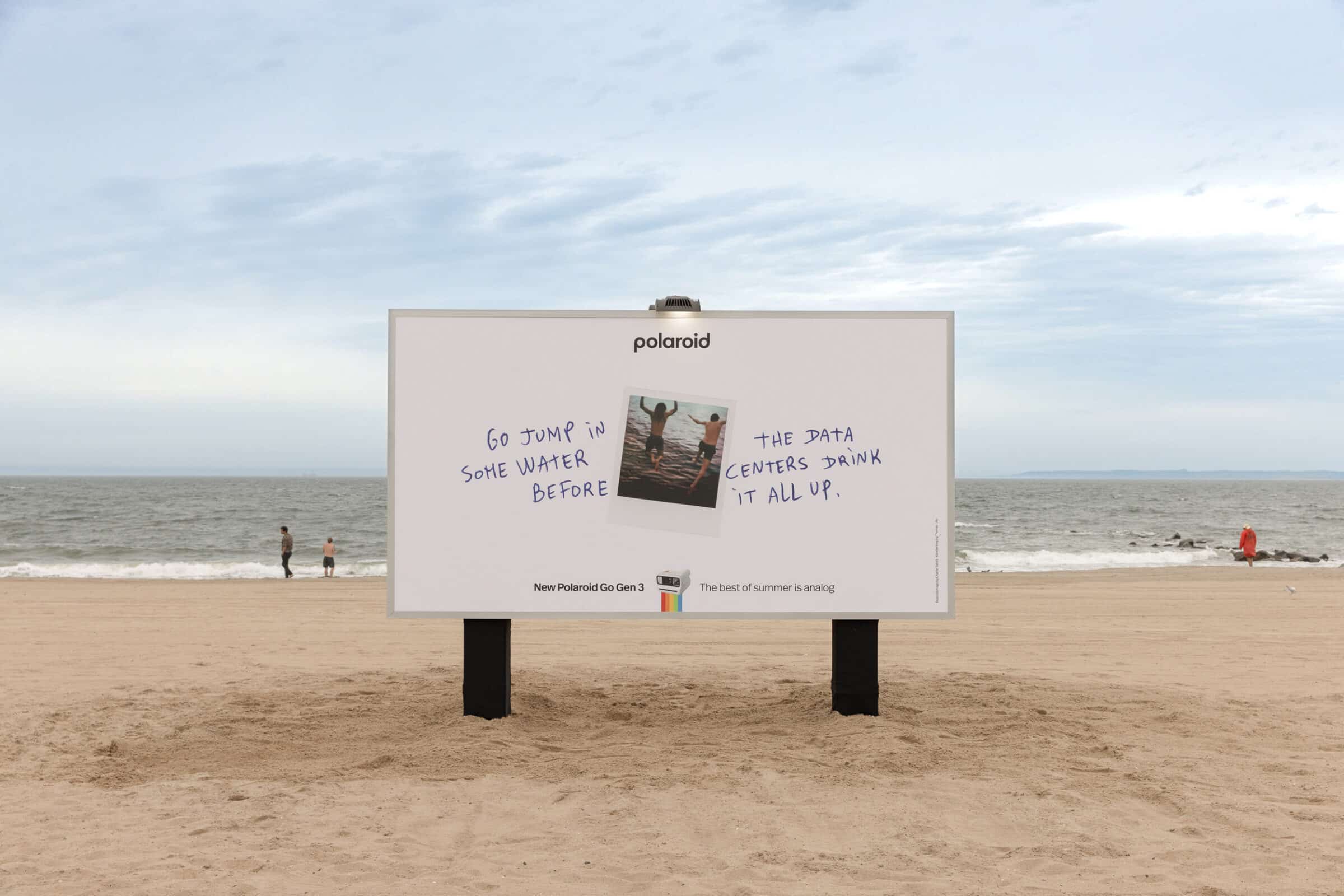
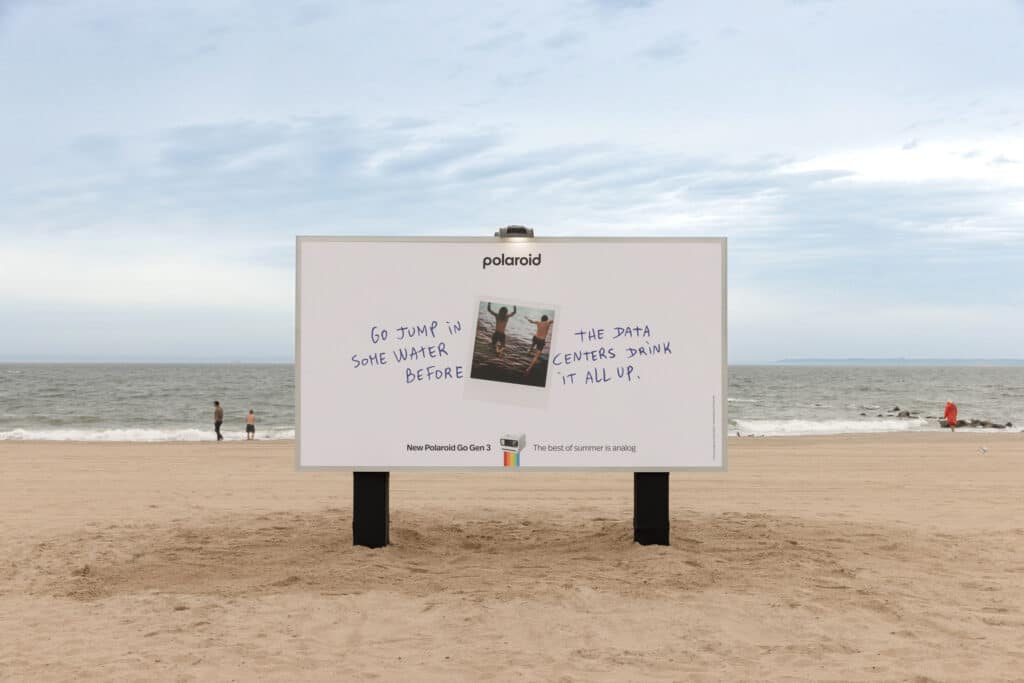
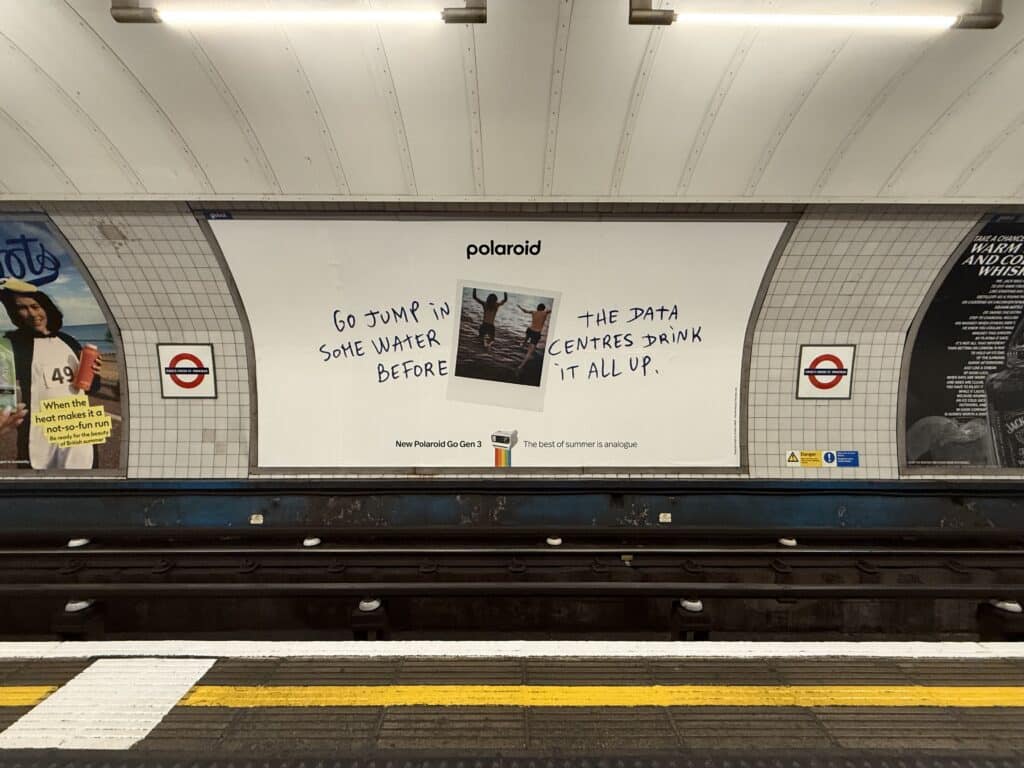
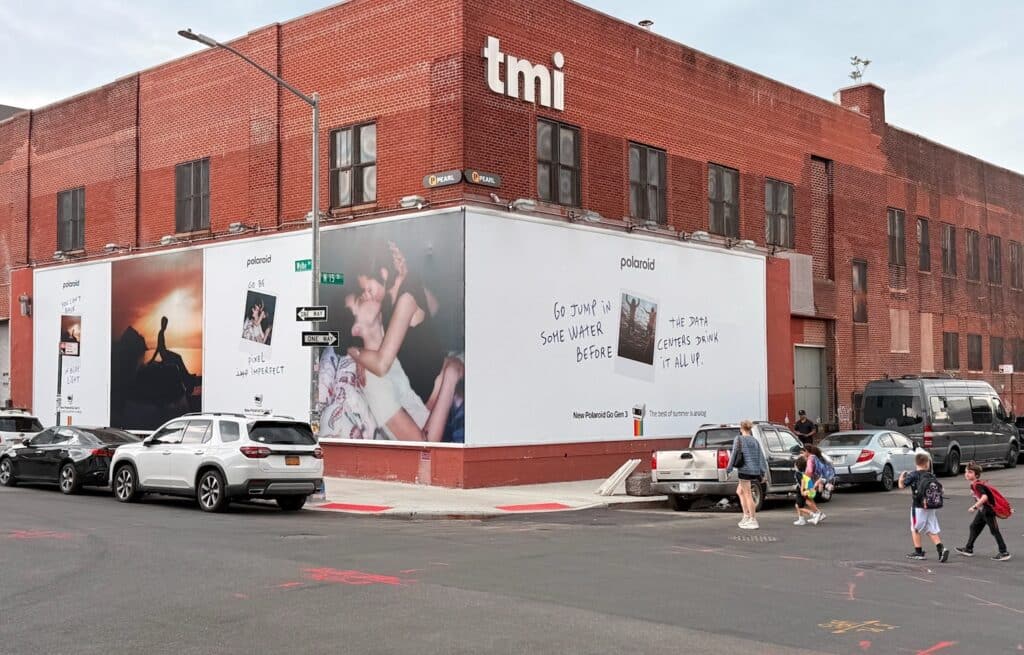
Polaroid planted a billboard in the sand at Coney Island this summer. It reads: “Go jump in some water before the data centers drink it all up.”
A small instant-camera company picked a fight with the entire AI industry, and somehow it’s winning. I saw it on my feed like everyone else did, and I will admit my first reaction wasn’t “clever marketing.” (Because I am in love with truly smart and creative marketing.) It was closer to relief. Someone finally said it.
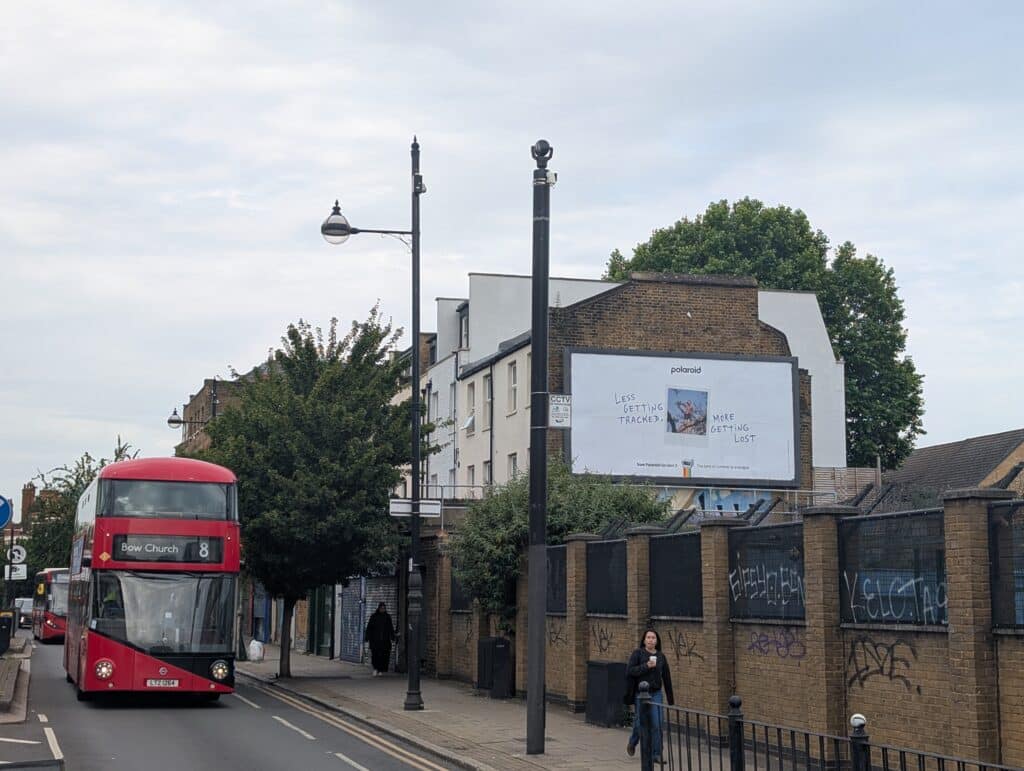
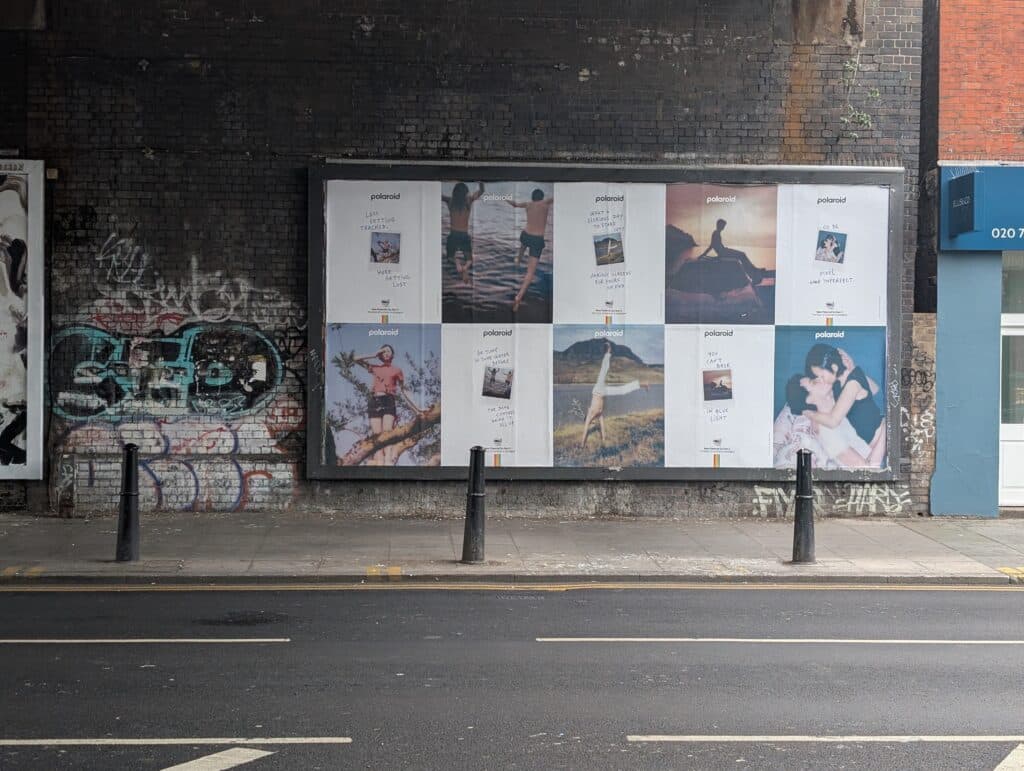
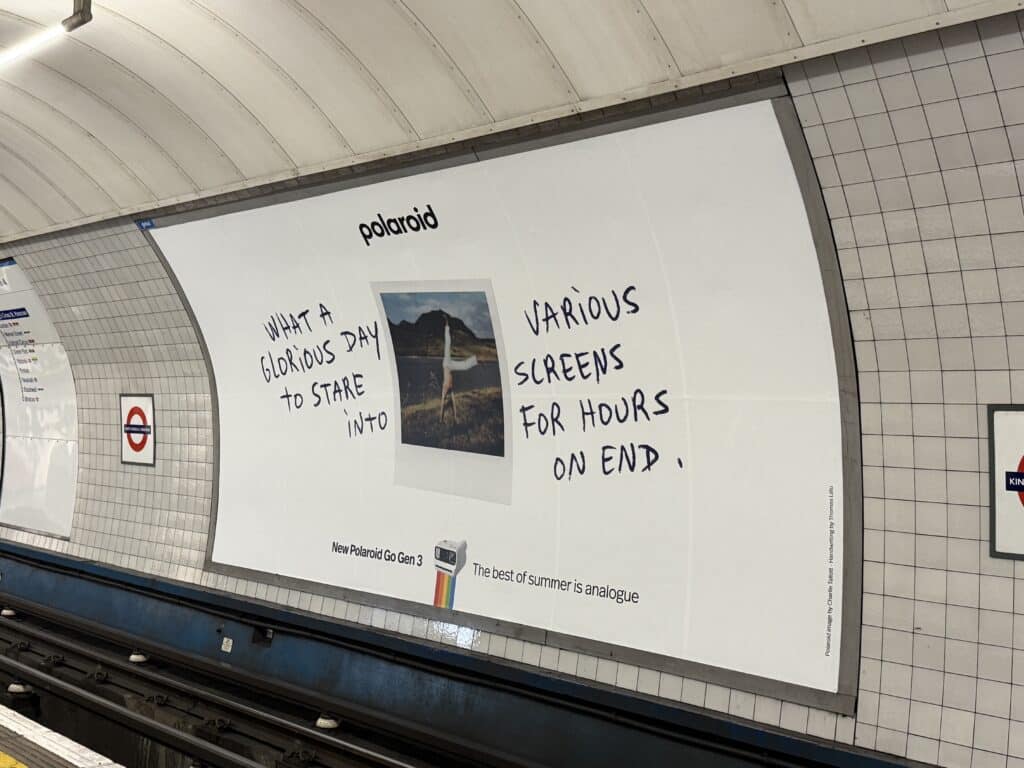
The billboard is part of a larger campaign called The Best of Summer Is Analog, designed to promote Polaroid’s newest Go camera. Across New York, London, and Seoul, the same blunt lines keep showing up.
“You can’t bask in blue light.”
“Dance like nobody is recording.”
“What a glorious day to stare into various screens for hours on end.”
Polaroid also paid twelve creators to log off social media for a while, announcing their breakthrough with handwritten notes to their followers.
One creator known online for dishing out dating advice from behind a screen apparently went out and tried actually dating people in real life instead. Creative director Patricia Varella insists the company isn’t anti-tech, and that the brand knows it has to live alongside digital life while still considering itself deeply pro-human. I believe her, honestly. This doesn’t read like a company trying to shame anyone into buying a camera. It reads like a company that noticed something true and decided to say it plainly, which is rarer than it should be.
Why I Think This Actually Landed
I don’t think campaigns go viral by accident. This one worked because it said something a lot of us are already feeling and rarely admit out loud, even to ourselves.
✿ Thank you for reading!
Subscribe and join us - no spam, just good vibes, once a month.
The timing lines up with real numbers, not just a mood. A recent Gallup survey found Gen Z’s hopefulness about AI has dropped nine points to just 18 percent, while anger about the technology has climbed to 31 percent. That’s not a fringe reaction from a few loud people online. But it is a generation that grew up plugged in, and Gallup’s own researchers point out that anger runs strongest among the oldest Zoomers, the ones who best understand what the technology is already changing about their work and daily lives. More broadly, seven in ten Americans say they don’t want an AI data center built anywhere near them. And yes, I am one of them. Clearly, Polaroid didn’t invent that anxiety. It just put a sentence on a billboard that matched what a lot of people were already carrying around quietly.
The Part I Think Nobody Wants to Say Plainly
Here’s where I will offer my own opinion instead of just reporting the campaign. I think the exhaustion this billboard is tapping into is a real psychological weight, not just an aesthetic complaint about screens.
Constant connectivity changes how our nervous systems operate. Notifications, infinite scroll, algorithmic feeds, they are built to keep us in a low-grade state of alert. Checking. Refreshing. Comparing. Over time, I think that steady hum of stimulation crowds out the kind of unstructured, undocumented experience that used to just be normal. An afternoon at the beach that existed only in memory, not in a feed. When every moment is a potential post, the moment itself shrinks. It gets filtered through how it will look to someone else before it has even finished happening to you.
AI adds a second layer on top of that, and this is the part I find most personally unsettling. It’s not only that people are anxious about job displacement, though that concern is legitimate. It’s something subtler. A creeping sense of losing authorship over your own thinking, your own writing, your own ideas, the feeling Gallup’s researchers described as losing agency to systems you never chose and don’t fully control. I’d call that a mental health issue every bit as much as a technology issue. A chronic loss of a sense of control is one of the most consistent predictors of anxiety that psychological research keeps turning up, no matter what’s causing it.
Polaroid’s marketing team clearly understands this, whether or not they would ever put it in clinical terms. An instant photo forces a kind of presence that a phone camera doesn’t. You take one shot. You wait. You watch it develop in your own hands, and then it’s done. No editing, no filtering, no audience to perform for while it happens. I don’t think that’s nostalgia. I think it’s a real structural difference. It strips away the layer of self-surveillance that digital life adds to almost everything now, even something as simple as a walk on the beach.
What I See
I will add something here that I don’t think gets said enough, and it’s the reason this campaign hit me harder than a clever ad usually does. As a clinical mental health counselor, I sit across from young women every week who are dealing with something that doesn’t have a clean name yet, even though it has a very real shape.
Sadly, some of the most brilliant, capable women I work with are the ones struggling most with this. They compare themselves against a version of another woman’s life that was built for an audience, not lived for its own sake, and the comparison becomes compulsive. It starts to look less like admiration and more like monitoring. Checking a profile repeatedly. Tracking someone’s updates is the way you would track a project at work. In session, that behavior sometimes edges close to what most clinicians would recognize as a pattern of stalking, though almost no one names it that plainly to themselves.
What strikes me most is how they try to make sense of it. They reach for pop psychology language they picked up online and ask me, almost like they’re diagnosing themselves before I get the chance to say anything, “am I obsessed?” I understand the impulse. Naming something feels like control. But a borrowed label from a fifteen-second video isn’t the same as understanding what’s actually happening beneath the behavior, and sometimes it leads people to stop looking at one question too early.
That’s the piece I think this billboard is circling without quite landing on it. It’s not just that we’re overstimulated. It’s that an entire generation of sharp, high-achieving women has learned to measure themselves against a feed instead of against their own lives, and the toll of that shows up in my office far more often than I think most people realize.
What I Actually Think Helps
I am not going to pretend throwing your phone in the ocean is a mental health plan, and to Polaroid’s credit, that isn’t really their pitch either. What I think is more useful and more realistic is smaller and more repeatable. Build in stretches of time, even short ones, where nothing is being recorded, optimized, or measured. Not because analog is morally superior to digital. I don’t believe that. But because a mind that never once gets to be unobserved doesn’t get much of a chance to just be itself.
The billboard in the sand is a joke with a real point buried inside it. The data centers aren’t coming for the water in any literal sense that should keep you up at night. But the attention economy they run on has been drinking something from us for years, and I think it’s worth noticing what we have left before we decide how much more of it to hand over.
As summer winds down and fall gets closer, I find myself thinking about this more, not less. I hope you get a few more weeks of dancing without anyone recording it, of doing things just because they felt good in the moment, and not because they needed proof.
And maybe, as a kind of New Year’s resolution before the actual New Year, consider limiting how much you follow other people’s lives or behaviors online. Not out of judgment toward anyone, but because I think we could all use a little more room to just be in our own lives instead of watching everyone else’s. Right?
References
Polaroid Newsroom, “Polaroid drops another provocative reminder that the best of life is analog, this time on Coney Island beach” (June 18, 2026), https://press.polaroid.com/266982-polaroid-drops-another-provocative-reminder-that-the-best-of-life-is-analog-this-time-on-coney-island-beach/
Gallup/Walton Family Foundation/GSV Ventures Gen Z AI survey (2026); Gallup topic research on AI and data center sentiment (2026).